Mental Health Program
Mental Health Program
Mental Health Assistance Program (MHAP)
Former political prisoners and family members are in many cases victims of trauma, depression, post-traumatic stress disorder (PTSD), and anxiety. AAPP has, in collaboration with John Hopkins University (JHU), developed a Mental Health Assistance Program (MHAP) to provide trained professional counseling to former political prisoners and their families.
At the beginning of this joint project, a qualitative-research team identified the most common mental health problems facing political prisoners in order to find an accurate approach to treat these issues. The project with JHU started in 2010 at the Mae Sot office, later expanding into Burma at our Rangoon and Mandalay centers. After examining the results of the qualitative research data, the most appropriate approach to treat the damage prison and detention causes was a technique called Common Elements Treatment Approach (CETA) which includes Cognitive Based Therapy, Cognitive Processing Therapy, Interpersonal Psychotherapy, Exposure Therapy, and Behavioral Activation. These key therapies aim to teach patients different methods of dealing with depression, anxiety, and trauma.
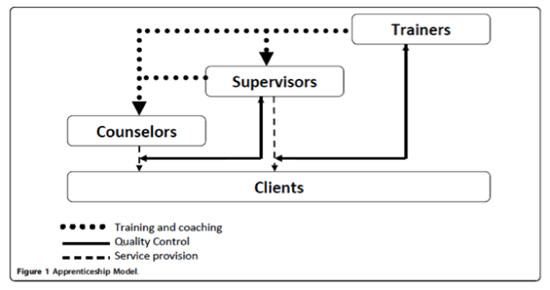
The practice of counseling former political prisoners started in 2011. Due to a lack of understanding of mental problems, JHU developed a sustainable Apprenticeship Model. The aim is to create a sustainable program, where professional mental health counselors train local MHAP teams in a variety of mental health counseling and therapy methods. Local clinical supervisors provide on-going assistance, training and leadership to counselors, whilst supervisors offer support and ongoing training to local clinical supervisors. Through both these processes, decisions regarding treatment plans are closely monitored.
In Burma, in-house trainings started between February and March 2013. At the beginning of 2013 we had five new counselors and one supervisor in Rangoon, while the center in Mandalay had three counselors and one supervisor. In early 2014 we have extended the team to fourteen counselors and four supervisors in Rangoon, two counselors and one supervisor in Mandalay, and five counselors and one supervisor in Mae Sot. The chief clinical supervisor, Kyaw Soe Win (based in Mae Sot), and the deputy chief supervisor, Saw That Tun (based in Rangoon), are responsible for the three MHAP centers located in Mae Sot, Rangoon, and Mandalay.
From May to September 2013 a total number of 96 clients, including former political prisoners and their families, have been treated in Burma. In Mae Sot, around 180 clients have been treated from 2011 to the present date.
In conclusion, MHAP is one of the key assistance programs that provides a platform for dialogue and exchange of experiences for political prisoners, by former political prisoners. The MHAP program is a rapidly expanding and essential part of AAPP’s assistance programs, having received positive feedback from those former prisoners who have benefited from MHAP. Through the continued growth of MHAP, AAPP is confident in expanding the number of mental health centers across Burma and increasing the numbers of professional counselors in order to meet all the needs of former political prisoners and their families.